Why does my teen forget things every morning?
Organization is an advanced executive functioning skill: the foundational skills have to develop first before organization can.
Many teens and tweens are not auditory learners. They need to see their things, not be told about them.
A launch pad is one spot, in the path they already walk, where everything for school lands and gets picked up.
Every item on the launch pad is labeled, and the teen owns it — this is not a system a parent runs for them.
Colleen Yanez has worked with teens and tweens for 27 years.
Organization is an advanced executive functioning skill, and most teens do better seeing their things in one spot than trying to remember them.
If mornings at your house are chaotic — your teen or tween is forgetting their items, running back upstairs to grab something, and then you get in the car and they have to run back inside again — this one is for you.
One of the executive functioning areas is organization. And believe it or not, it's actually an advanced area. That means all the foundational areas of executive functioning have to be developed first, before organization can be. So it can be really tough for kids. A lot of the time they're also not auditory learners. They need to see things.
So what I came up with is something I like to call the launch pad.
What is the launch pad?
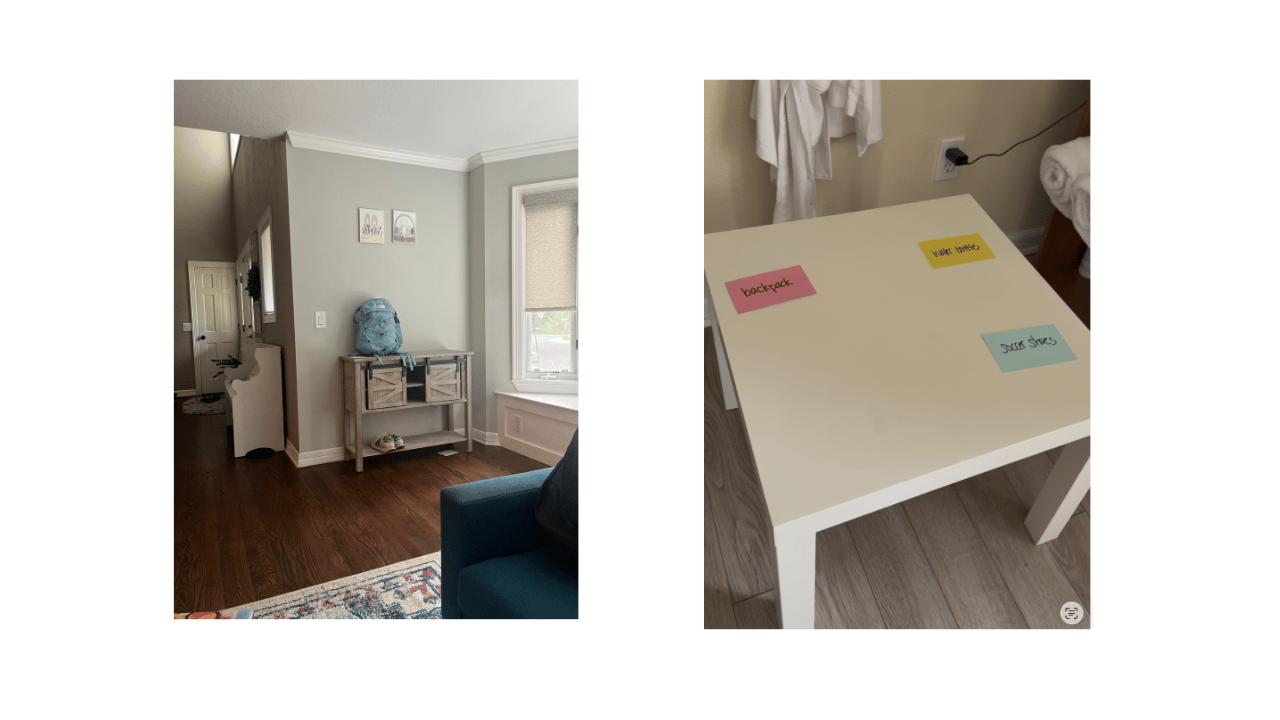
Two different examples of launch pads
The launch pad is one established area where your teen or tween is going to see it on their way in after school, and on their way out in the morning.
That's the whole idea. Everything for school lands there when they walk in, and everything leaves with them when they walk out.
Where should the launch pad go?
In the path they already walk. Not a tidy corner of their bedroom where nobody goes, and not a closet — somewhere they physically pass coming in the door after school and heading out in the morning.
What should I use for it?
I like talking about a little IKEA table. They're cheap, you can write on them, you can even have your teen or tween paint it, whatever. And who cares if something happens to it!
If you already have another area that works just fine, go for it. The table isn't the point. The spot is.
What goes on the launch pad?
Have your teen or tween label all the items they need each day for school success.
When they walk in after school, that's where their items go. That's where their phone gets charged. That's where their computer gets charged. Everything lands on the launch pad.
When it's time for homework, they go and pick up what they need. After they're done with their homework, they put it back. In the morning when they're leaving, they just take it and walk right out.
And yes, it really is that simple.
Why does everything need to be labeled?
Labels are one of the keys, and they're the part that makes this work for a teen who needs to see things rather than hear them. A labeled spot tells them where something goes without anyone having to say it out loud.
Who is in charge of the launch pad?
Your teen. This is not something you do. This is something they own.
When they forget to put something in its place, ask them where it's supposed to go. That question does more than putting it there yourself would.
What if they forget something anyway?
Further on down the line, I'd recommend that if they forget something, they forget something.
Here's what's happening when you bring it: they are training you. Every single time they forget something and you bring it, they learn that they don't have to remember. But that one time you don't come? They're not going to forget it again, especially if there's a big enough consequence at school.
So unless their life is in jeopardy, let them live!
I know that's the hard part. It's much easier to drive the binder up to the front office than to let a kid sit with a missing binder. But the drive teaches one thing and the missing binder teaches another.
Where do I start?
Real simple. An area on the way in that they can see, where they put all their stuff down — and then they grab it on the way out.
That's it. That's the launch pad.
If the problem at your house looks less like forgetting and more like homework stretching all evening, that's a different executive functioning skill. I wrote about that one here: Why Does My Teen's Homework Take Three Hours?
Wondering what else you can do to support your teen or tween? My free quiz is built for middle school parents, but anybody can take it. It walks you through which executive functioning area may be your teen's most challenged area, and gives you strategies that can help.
I'm Colleen Yanez, founder of Key Coaching. I'm a National Board Certified Teacher and executive functioning coach, and I've spent 27 years working with teens, tweens and their families. I work with families in Parker, Colorado and virtually nationwide.